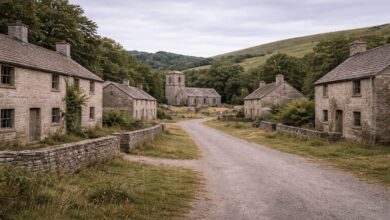
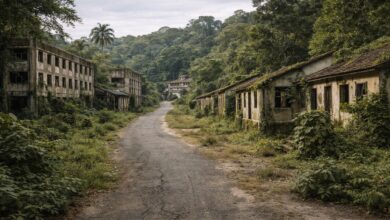
In the far north-eastern reaches of Russia, within Magadan Oblast, the former mining town of Kadykchan sits in enforced stillness. Apartment blocks line a planned grid. Schools, shops, and public buildings remain legible. Inside many homes, furniture was left where it stood. Tables face windows. Cabinets hold nothing, yet remain closed. Beds sit beneath peeling walls. Kadykchan was not abandoned gradually through economic drift. It was emptied with urgency after disaster, leaving behind a town that looks as if residents departed expecting to return.
Kadykchan’s impact comes from immediacy. The town does not feel aged into abandonment. It feels interrupted.
A settlement built for permanence
Kadykchan was established during the Soviet era to support nearby coal mining operations. Unlike temporary camps, it was planned as a permanent settlement. Multi story apartment buildings, cultural centers, schools, and infrastructure were designed to sustain families through extreme climate.
Life followed institutional rhythms. Work shifts structured days. Public services reinforced stability. The town was intended to endure. Similar human responses to silence and environment appear in mining settlement of Garnet.
Its architecture reflects confidence in continuity.
The disaster that changed everything
In the mid 1990s, an explosion at a nearby mine caused fatalities and revealed deeper structural and economic instability. Mining operations halted. The town’s sole reason for existence collapsed almost instantly.
With employment gone and safety in question, authorities moved quickly to relocate residents. Evacuation was encouraged and later enforced through withdrawal of services.
Departure occurred faster than adaptation.
Evacuation without dismantling
Residents left with limited time and uncertain futures. Many took personal essentials but left behind furniture and household items that could not be transported easily.
Buildings were not demolished immediately. Heating, power, and maintenance ceased.
The town crossed from occupied to empty without a transitional phase.
Furnished interiors as evidence of haste
What distinguishes Kadykchan from many abandoned towns is the presence of intact domestic interiors. Chairs remain pushed under tables. Wallpaper peels around framed spaces where pictures once hung.
These interiors imply routine paused rather than concluded. They suggest expectation of return that never materialized.
What remains visible today are the planned grid, intact public buildings, and everyday domestic interiors preserved in the state they were left.
Expectation lingers in arrangement.
Silence shaped by cold and distance
Kadykchan lies in a harsh climate where winter dominates much of the year. Snow muffles sound. Wind moves through empty corridors.
In such environments, silence feels expansive. It does not echo loudly. It absorbs.
The town feels sealed rather than open.
Why presence is often reported
Visitors sometimes describe a sense of presence in Kadykchan. This sensation is not tied to specific claims. It arises from intact order without activity.
Domestic spaces are designed for occupation. When they remain furnished but empty, the mind fills absence.
Presence here is psychological, not narrative.
Infrastructure without function
Schools, playgrounds, and public buildings remain identifiable. Their scale reflects collective life rather than individual use.
Without people, these spaces feel disproportionate. The town’s social skeleton is exposed.
Exposure amplifies loss.
Planned order turned static
Kadykchan’s grid layout still directs movement logically. Streets connect services. Buildings align with access.
Urban logic persists without population. Movement becomes symbolic rather than practical.
The town continues to organize space for no one.
Difference between abandonment and removal
Some towns are dismantled after evacuation. Kadykchan was largely left in place.
This passive abandonment allowed form to remain visible long after function ended.
Visibility sustains memory.
The role of distance
Kadykchan’s remoteness limited redevelopment and scavenging. There was little incentive to repurpose structures.
Isolation protected the town from transformation.
Distance preserved interruption.
Comparison with other mining towns
Many mining towns decline slowly as resources deplete. Kadykchan’s collapse was abrupt.
The speed of evacuation distinguishes it. There was no gradual emptying of rooms.
Rooms were left mid life.
Ethical attention and restraint
Kadykchan represents displacement following industrial disaster. Engagement with the site requires restraint.
Sensational framing risks trivializing lived experience.
The town is a record, not a stage.
Time without softening
Time has weathered surfaces but not reorganized space. Furniture remains. Layouts persist.
Decay has begun, but not erased intention.
Time here feels stalled.
Memory embedded in objects
Objects left behind carry disproportionate weight. They imply hands, habits, and routines.
When objects remain without users, memory becomes tangible.
Kadykchan’s interiors hold more memory than its streets.
Absence enforced by circumstance
Residents did not choose to leave gradually. Circumstance forced departure.
This lack of choice intensifies the emotional reading of space.
The town was not given time to say goodbye.
Why Kadykchan still matters
Kadykchan matters because it demonstrates how quickly planned permanence can dissolve. Infrastructure built for decades of use became obsolete in weeks.
The town shows the fragility of mono industry settlements.
Fragility leaves visible scars.
A town defined by interruption
Kadykchan did not evolve into something else. It stopped.
Homes remained furnished. Streets remained aligned. Life vanished.
Interruption defines its identity.
Enduring Perspective
Kadykchan endures as a mining town emptied almost overnight after disaster, where furnished homes remain without occupants. Its power lies in immediacy rather than age. The town does not feel historical. It feels unfinished.
In the cold landscape of Magadan Oblast, Kadykchan stands as a reminder that disaster can empty a place faster than memory can adjust. When people leave in haste, structure retains intention longer than life remains.
The town does not ask to be imagined differently. It asks to be recognized as a moment when continuity broke and never resumed. Related reflections on memory and perception can also be found in Pyramiden.
Horizon Report documents places shaped by memory, infrastructure, and human decisions. Our editorial approach focuses on what remains physically visible, how abandonment unfolds over time, and how interpretation is clearly separated from observable evidence.
For readers seeking deeper context, the following background articles explore how ghost towns emerge, why communities are left behind, and why preservation matters in understanding collective history.
- Abandonment And Ghost Towns
- What Is A Ghost Town
- Why Towns Are Abandoned
- Preserving Abandoned Places
Editorial transparency matters. Observations are grounded in site layout, materials, remaining structures, and documented timelines where available. Interpretive layers are presented as interpretation, not assertion.
Careful readers often notice details worth refining. Thoughtful feedback helps ensure accuracy, clarity, and long term editorial integrity.